




SEO · March 22, 2026 · 6 min min read
How to Know If My Website's SEO Is Well Done? The LCP Factor
Find out if your website is invisible to Google. Learn to measure LCP (Largest Contentful Paint) and avoid "technical death" from slow loading.
If you have the impression that your website does not rank, that it is a ghost website, or a digital brochure that only you know about; you need to know about LCP (Largest Contentful Paint). It is not just a technical term; it is your customer's real experience.
The purpose of this article is to teach you how, through a free and simple tool, you can obtain an “electrocardiogram” of your website. By measuring LCP, you will be able to visualize the real experience your customers have when entering your site. LCP is not a magic solution nor the complete SEO picture; it is a key piece of a much larger puzzle. However, this piece tells you where to move to improve your digital health.
What Exactly Does LCP Measure?
LCP (Largest Contentful Paint) measures the time it takes for the most important and bulkiest content on your screen to appear — such as your business's main banner or the title of the service the user is looking for. It is, essentially, the metric that defines when a page becomes “useful” in your customer's eyes.
Google uses it as a direct quality signal: if your page loads fast, you compete; if it is slow, no matter how good your information is, you simply will not appear in the top results.
A Major Obstacle: “Preloaders”
A very common technical mistake is the use of loading animations or Preloader JS. Although they may look modern visually, they often act as a wall that delays the display of real content. If this process exceeds 2.5 seconds, Google will classify your website as “slow”, invalidating any positive performance score that other superficial tools may have shown you.
The result: Google will instead show your competitors' pages that do have a superior LCP.
Remember: this is not a definitive solution, it is one piece of the puzzle.
Health Traffic Light: LCP Ranges
For your website to be competitive and not suffer from “structural invisibility”, you must be within these time ranges:
- 🟢 Optimal: Under 2.5 seconds — Excellent user experience.
- 🟡 Moderate: 2.5 to 4 seconds — Needs urgent improvements.
- 🔴 Bad (Technical death): Over 4 seconds — High abandonment risk.
Try This Now
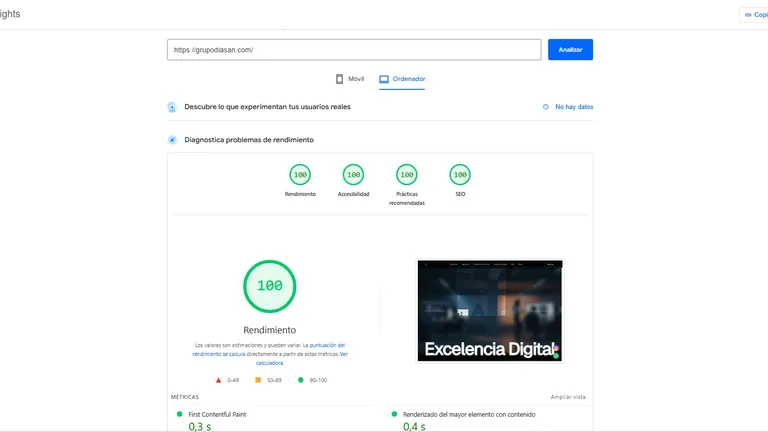
Paste your URL into the PageSpeed Insights text box and hit “Analyze”. The tool will do its job and show you the experience for Mobile and Desktop separately.
At the top you will see two independent tabs. Below, 4 scores will appear: Performance, Accessibility, Best Practices and SEO, each with a score between 1 and 100.
Do not focus on the 4 big numbers for now. Scroll down to where it says “metrics” and look for LCP. If it is orange or red, you have a serious user retention problem. Clicking on each area's detail expands the explanation of the specific problem.
Now, if you see that you have 100% in some categories, be careful — it may be a false positive. And below I explain why.
The 100% Deception: Can You Count to 10?
Imagine you hire someone to count from 1 to 10. That person counts: “One… two”, and stops. They did it fast, with a clear voice and no errors. Technically, their performance was 100%… but they only reached two.
That is exactly what PageSpeed measures. It tells you that what you have built loads fast, but it does not tell you that you are missing steps 3 through 10 for Google to take you seriously.
What That “100%” Is NOT Telling You:
- That you have no H1 tags (the main heading that tells Google what you sell).
- That your images are “blind” because they have no descriptive text (ALT).
- That you lack the necessary files that guide search engines.
- Lack of real SEO optimization or structure.
- And all the other puzzle pieces your website is missing.
Why Is LCP a Pillar That Really Matters?
LCP is not just a number to please Google; it is the thermometer of your site's immediate usefulness. A user looking for a specific service or product does not want to wait for unnecessary animations or decorative elements to load.
If the main content takes more than 4 seconds to appear, the user feels the site does not work and returns to the search engine to click on your competition. This is known as “technical death” by abandonment.
For Google, LCP is a signal of quality and commitment: if your site is fast, it is fit to compete; if it is slow, no matter how good your information is — you simply will not appear.
The Infrastructure That Guides Success
Following the 1-to-10 analogy, the intermediate steps consist of giving search engines a clear navigation guide. Many websites operate blindly because they lack an architecture that connects their pages to each other or gives precise instructions on what should and should not be indexed.
Without a sitemap, correct optimization and professional crawl control, Google has to “guess” how to navigate your website — and Google brings customers, it is not there to guess. This can cause your most important services to be left out of results forever.
As we analyzed in Technical SEO in Mexico 2026, the difference between businesses that appear on Google and those that do not lies in the engineering nobody sees.
Conclusion: LCP Is Your First Diagnosis, Not the Last
Checking your LCP is the first step of your digital structural checkup. It is the metric that tells you whether your website exists for your customers or is technically invisible. But remember: it is one piece of the puzzle, not the whole puzzle.
The next step is understanding what other pieces your website is missing to appear on Google — and that requires a deeper look at your entire digital architecture.